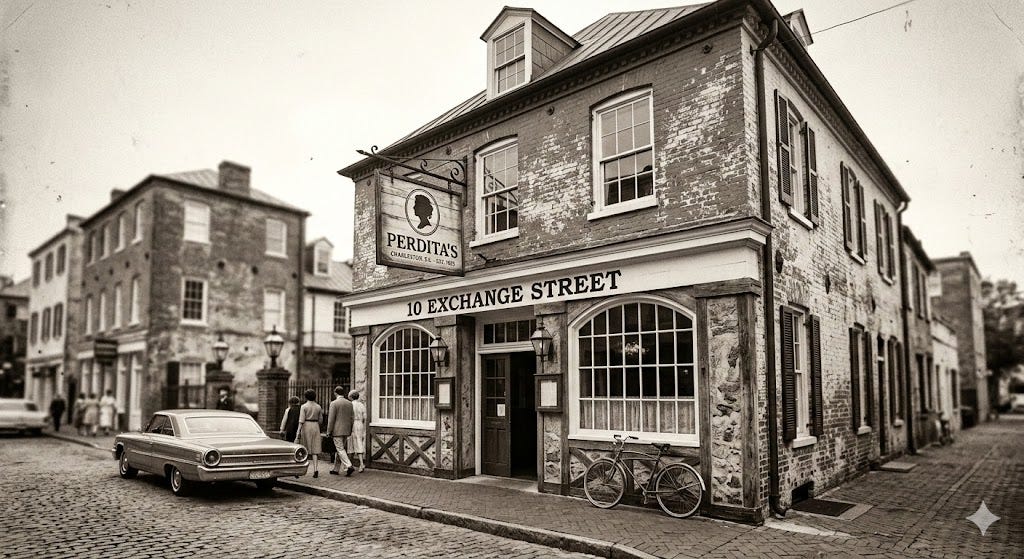
Perdita’s was more than just a restaurant; for decades, it was the “undisputed queen” of fine dining in Charleston. Tucked behind the 1740s brick walls at 10 Exchange Street in Charleston’s historic French Quarter, it defined the city’s culinary elegance from its opening in 1953 until its closure in the 1980s.
Today, the building remains a living piece of history and resilience, surviving centuries of hurricanes and earthquakes. It is currently a focal point forUndiscovered Charleston, where Chef Forrest Parker leads tours that connect the physical “ghosts in the brick” to the modern flavors of the Lowcountry. This era marked the birth of the refined Lowcountry aesthetic.
Perdita’s was internationally recognized in an era( 1953- the late 20th Century) when Charleston was not yet the global “foodie” destination it is today.
Prestigious Honors: It was one of only five restaurants in the United States to receive the Medal of Honor from the Council of Paris, a testament to its French-influenced excellence.
The Vibe: It was known for its handwritten nightly menus and “old-school” luxury. The interior featured heavy wood columns, white tablecloths, and velvet-lined booths.
Signature Dishes: Its menu was a blend of high French technique (think truffles and foie gras) with local Lowcountry ingredients. Famous dishes included Perdita’s Fruits de Mer (a bouillabaisse-style stew) and Lump Crab Cakes Remick.
Lump Crab Cakes Remick was created about 1920 at the Plaza Hotel in New York City and named in honor of the then-current president of the stock exchange, William Remick. With our abundance of local blue crab, the recipe was quickly adopted as our own. The recipe itself is wonderfully simple but quite elegant.
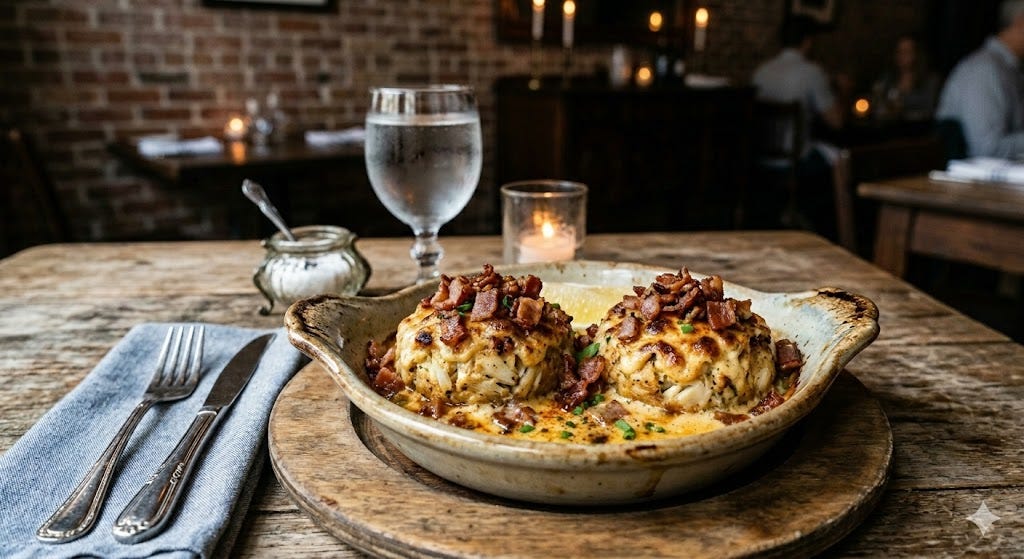
Recently, former SC Chef Ambassador Forrest Parker shared the authentic recipe for The Baked Crab Meat Remick from his personal archives. This historic gratin was the essence of Perditas, the midcentury Charleston landmark. This was the era when it shared a pedigree with the finest dining rooms in Paris. The dish has the sweetness of our Atlantic blue crab but is sharpened by a glaze of mustard and tarragon vinegar, then amplified by the smoky salt of crisp bacon. It’s a dish that’s elegant, coastal, and must be unhurried.
Perdita’s was internationally recognized in an era( 1953- the late 20th Century) when Charleston was not yet the global “foodie” destination it is today.
Prestigious Honors: It was one of only five restaurants in the United States to receive the Medal of Honor from the Council of Paris, a testament to its French-influenced excellence.
The Vibe: It was known for its handwritten nightly menus and “old-school” luxury. The interior featured heavy wood columns, white tablecloths, and velvet-lined booths.
Signature Dishes: Its menu was a blend of high French technique (think truffles and foie gras) with local Lowcountry ingredients. Famous dishes included Perdita’s Fruits de Mer (a bouillabaisse-style stew) and Lump Crab Cakes Remick.
Lump Crab Cakes Remick was originally created about 1920 at the Plaza Hotel in New York City and named in honor of the them current president of the stock rxchange, William Remick. With our abundance of local blue crab the recipe was quickly adopted as our own. The recipe itself is wonderfully simple but nevertheless quite elegant.
As of February 2026, Revival (located in the Vendue Hotel at 162 East Bay St.) is still very much a cornerstone of the Charleston dining scene, having recently been recognized as one of the best fine-dining spots in the world. However, their menu has evolved.
The “Crab Cake Remick” Status
Can you still get it?
While it isn’t on the nightly menu, Revival at the Vendue Hotel is famous for its “Revival Through Time” program, where they rotate classic recipes from Charleston’s past. Because the Crab Cake Remick was such a staple for them for years, it occasionally returns as a seasonal special or for commemorative events.
While Perdita’s Lump Crab Cake Remick—is no longer listed on their current standard dinner menu the kitchen has shifted focus to other historic “revivals,” most notably:
William Deas’ She Crab Soup: This is currently their flagship “history” dish. It uses the original recipe from the early 1900s, featuring lump crab, Amontillado sherry, and crab roe.
Lowcountry Pirlou: A heritage rice dish using Carolina Gold rice, lobster, and shrimp.
For the authentic recipe for Perdita’s Baked Crab Meat Remick we thank Chef Forrest Parker. Recipe below.
Perdita’s Baked Crab Meat Remick
This dish is a celebration of the era when Charleston’s culinary scene was as vast as the sea and proof that our local cuisine belonged on the international stage.
Ingredients
1 ½ poundsfresh white lump crab meat, carefully picked for shells
9 stripsbacon, cooked until crisp and crumbled
1 ½ teaspoonsdry mustard
¾ teaspoonpaprika
¾ teaspooncelery salt
3 to 4 dropsTabasco, or to taste
¾ cupchili sauce
1 ½ teaspoonstarragon vinegar
2 ½ cupsmayonnaise
Preparation
Step 1: Heat oven to 375 degrees. Divide the crab meat evenly among six shallow individual baking dishes or ramekins. Place in the oven to warm through, about 5 to 7 minutes.
Step 2 While the crab warms, prepare the glaze: In a medium bowl, whisk together the dry mustard, paprika, celery salt, and Tabasco. Whisk in the chili sauce and tarragon vinegar until combined.
Step 3: Gently fold the mayonnaise into the chili sauce mixture until smooth and uniform in color.
Step 4: Remove the crab from the oven and top each portion with the crumbled bacon. Spoon the sauce generously over the top of each dish, spreading it to the edges.
Step 5: Switch the oven to broil. Place the dishes on the top rack and broil until the glaze is bubbling and lightly bronzed, about 2 to 3 minutes. Serve immediately.