Charleston's Seafood Empire: Built From a Rowboat
The story of Charles C. Leslie, architect of Charleston's seafood culture.

Indescribable joy accompanies the arrival each spring of our beloved soft-shell blue crabs. These beautiful swimmers create enough ecstasy to cause even the angels to sing. Festivals are everywhere, and blue crabs become like little pied pipers, leading locals and visitors to the nearest restaurant.
In small towns like McClellanville and Murrell’s Inlet, blue crabs bubble peacefully in long, shallow bathtubs all along the coastal Carolinas. These are holding tanks for the blue crabs in various stages of molting or shedding their outer shells. Rather than scouring the ocean floor for soft-shelled crabs, fishermen capture them before they molt and hold them in saltwater tanks. As soon as the crabs drop their shells, they’re pulled out of the tank, which stops a new exoskeleton from hardening. After shedding its old shell, the crab expands by pumping water into its body, and the new shell begins to form.
We recognize and honor Reconstruction-era maritime pioneer Charles C. Leslie, who brought these briny delicacies to our plates. It’s a story that transitioned from “creek-bank” survival to a world-renowned culinary identity.
His journey from the son of a modest household to one of Charleston’s wealthiest Black entrepreneurs is a legendary tale of local expertise, wartime risk, and industrial defiance.
Armed with this scientific knowledge, Leslie established the region’s first commercial soft-shell crab nursery on Shem Creek. By monitoring molting cycles and protecting vulnerable crabs in shoal ponds, he stabilized a delicacy previously limited to chance harvests. Soft shell crab shifted from a rarity to a seasonal ritual, allowing Charleston hotels and restaurants to reliably serve what Leslie called the “transitory luxury” of the soft shell.
A Self-Taught Master of the Sea
While most doors were barred to men of color in the mid-1800s, Leslie forged his own key. Homeschooled in reading, writing, and mathematics, he possessed an intellectual edge that he quickly applied to the water. As a teenager, while others saw only waves, Leslie saw a map. He obsessed over the Charleston coastline, memorizing every treacherous sandbar and hidden inlet. By the dawn of the Civil War, he wasn’t just a sailor—he was a supreme pilot, a man whose intimate knowledge of the harbor made him indispensable to merchants desperate to move goods through tightening waters.
War, Risk, and the Cuban Connection
The Civil War years remain shrouded in mystery—the private diary detailing his exploits was tragically lost in the mid-1900s—but the echoes of his ambition remain. In his early twenties, Leslie allegedly turned his genius for navigation into a high-stakes gamble, running supplies and armaments through the very waterways he had spent his youth mastering.
By the war’s end, Leslie emerged not just with experience but with capital. He struck a powerhouse partnership with a Cuban ship captain, A. Frances Lopez, and together they built a fleet from the ground up. They were innovators as much as sailors, engineering proprietary nets and traps designed to be “theft-proof,” ensuring their bounty stayed their own. As a pioneer of Black industry, Leslie became a major employer, hiring newly freed men and providing a lifeline of wages in a volatile post-war economy.
The Battle for the Deep: Mosquitoes vs. Smacks
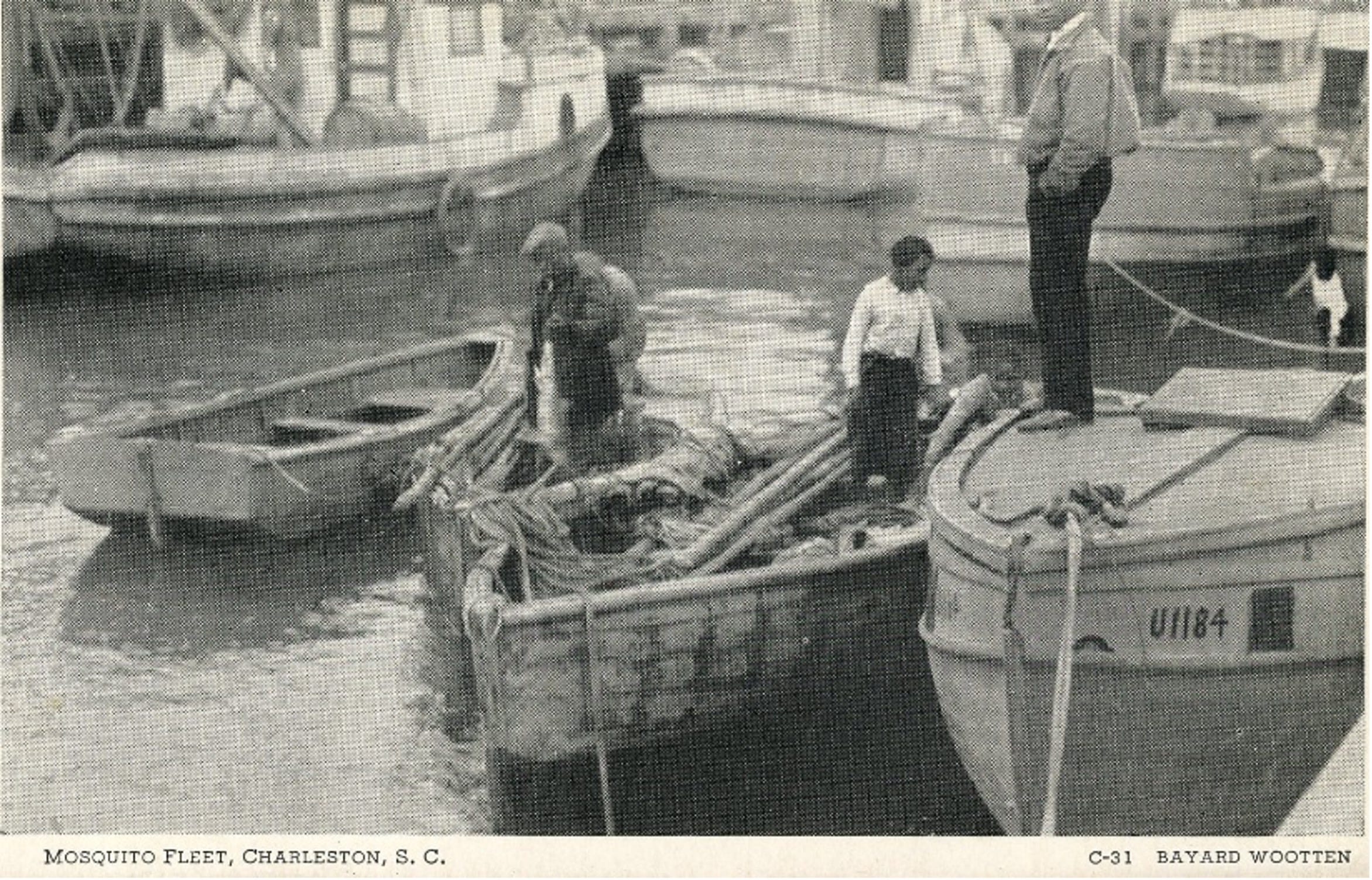
Post-war Charleston became a watery battlefield. Leslie’s operation stood at the heart of the “Mosquito Fleet”—a brave armada of African American fishermen in small boats who dominated the local harvest, organized by Leslie. They found themselves in a David-vs-Goliath struggle against the “Smack Fleet,” massive Northern-owned operations that swept the offshore waters for shad and bass. After 1865, and the end of the Civil War, Leslie saw opportunity where others saw ruin.
Against the weight of Northern capital and the remnants of Southern prejudice, Charles C. Leslie didn't just survive—he conquered, proving that local expertise and a rowboat could indeed build an empire.
The "Mosquito Fleet" wasn't just a group of fishermen; it was a vibrant, floating culture that defined the rhythm of Charleston’s harbor for decades. Named for the way their small, white sails looked like a swarm of insects on the horizon, these men—primarily African Americans—created a lifestyle built on skill, communal survival, and extreme physical endurance.
They would depart around 2 a.m. in small rowboats from the Charleston wharf. They often rowed or sailed up to 20 miles offshore to reach the blackfish banks. Perilous work. No GPS or motorized engines. They relied on the stars and their own knowledge of the currents. No industrial nets. The gear was simple. Handlines with multiple hooks. It’s hard to imagine the patience required and the skill against the great Atlantic.
Their boats were small - 15 to 25 feet. When sudden squalls hit, the fleet had to stick together to survive. Work songs were similar to the Gullah Geechee traditional songs they often sang while working on the plantations. They sang rowing songs - songs that helped men coordinate their rowing during the long trek back to the harbor.
The market hustle extended to the very streets of Charleston. Street criers with their wives and family members carried the day’s catch through the streets in baskets balanced on their heads. Melodic street cries, singing out the names of the fish - “Whiting! Live Crab!” alerted housewives and chefs that the bounty had arrived.
He even championed the shrimp industry; shrimp were often used as bait, but he began selling them for food. He not only sold these newly celebrated delicacies from his retail locations, but he also began selling wholesale to other retail markets, restaurants, and hotels, and shipping to northern markets. Local chefs became enthralled with the expanded options and developed new recipes for public consumption. It is no coincidence that standard Charleston dishes like crab pilau (also known as perloo) and shrimp and grits came into fashion in the late 1800s.
Under his influence, “creek-bank-food” became the foundation of the modern Charleston dining identity.
A Legacy at 72 Anson Street
In 1904, he purchased the Kohne-Leslie House at 72 Anson Street, anchoring his legacy in the neighborhood now known as Ansonborough. When he died in 1911, two days after his 70th birthday, the city paused for a two-day funeral—a final tribute to the man who mastered both the harbor and the table.
By the 1880s, Leslie and Terry dominated much of the Charleston seafood market, and Leslie’s wealth had grown substantially. This allowed him to invest in the Black community — assisting in the building of a church and a bank for African Americans, participating in fraternal organizations, and engaging in politics. He felt the call to improve conditions for his fellow African Americans and to set an example of Black wealth building. Nothing illustrated this more than the purchase of his grand house in Ansonborough in 1904, at the age of 63. The home at 72 Anson Street — now known as the Kohne-Leslie House, and previously the Benjamin Simons Neufville House — was clearly a source of great pride. This gorgeous 4,433-square-foot Greek Revival home was shared with only his wife and one daughter for a mere seven years before his passing in 1911, at the age of 70.
Today, Charleston’s seafood scene continues to honor these roots by emphasizing local tide-to-table sourcing and preserving the Gullah Geechee techniques that first made the harbor famous.
Subscribe now and help preserve the soul of this region through stories of the often unsung heroes who came before us. Let’s preserve our heritage for the generations to come. Hit the Subscribe button now.


