
It's Heritage Week on Hilton Head Island!
Memories of Arnold Palmer, some scotch and a boat ride.

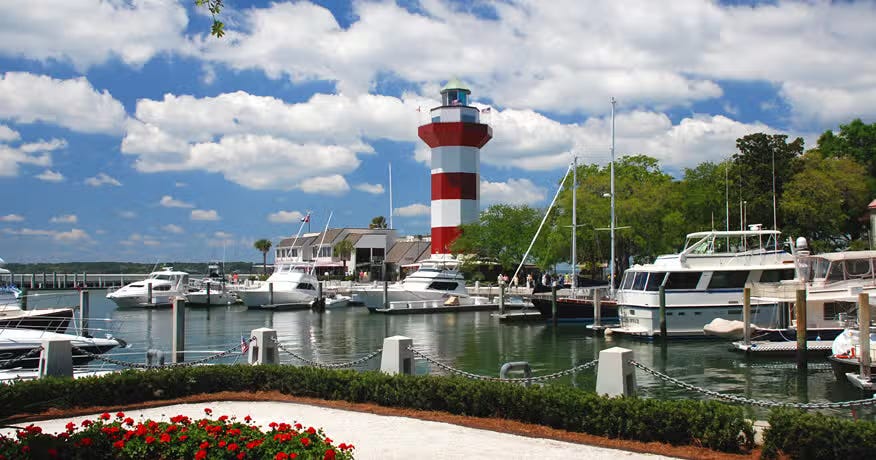
This week, as the world’s best golfers take on Harbour Town Golf Links, we’re looking back at the visionary who saved the trees, protected the land, and put Hilton Head on the map
Before Hilton Head was a world-class destination, it was a quiet outpost known only to a few hundred residents. Charles Fraser didn’t just build a resort; he pioneered a “harmonious partnership” between nature and architecture that still defines the island today. From saving the Liberty Oak to building a “folly” of a lighthouse, Fraser’s stubborn genius paved the way for the RBC Heritage.
By the mid-1950s, Hilton Head Island was a place the modern world had largely forgotten. It was a quiet, rural outpost of 500 residents—mostly farmers, oystermen, and timbermen—accessible only by ferry and governed by the rhythmic pull of the tides. But in 1956, a bridge spanned the water, and with it came a young Yale Law graduate named Charles Fraser. He didn’t just bring a blueprint for a resort; he brought a radical philosophy that would rewrite the rules of American development.
While other coastal developers of the era were busy bulldozing dunes and laying down rigid, grid-like streets, Fraser envisioned something different: a “harmonious partnership” between nature and architecture.
His dream was rooted in a core philosophy that beauty and profit weren’t mutually exclusive. To Fraser, a community could thrive only if the developer protected the very soul of the land. This led to a series of choices that his contemporaries considered revolutionary—if not outright crazy:
The Curve of the Road: Instead of clearing ancient oaks, Fraser mandated that roads bend and weave around them. His devotion to the canopy was so fierce he famously spent $50,000—a small fortune at the time—to save the Liberty Oak during the construction of Harbour Town.
The Camouflage of Home: He pioneered “Sea Pines Style,” requiring homes to be built with natural wood shingles and earth-toned palettes. The goal wasn’t to dominate the landscape, but to disappear into it.
A Gift to the Future: In a move that stunned real estate moguls, he set aside 605 acres of prime development land to remain perpetually wild. Today, the Sea Pines Forest Preserve remains the heart of the island.
The Birth of a Classic
By 1969, Fraser was ready to show the world his creation, but he needed a stage. He founded the Heritage Classic, the only PGA TOUR stop in South Carolina. Skeptics once again scoffed; the event was scheduled for Thanksgiving weekend on a brand-new, unproven course called Harbour Town Golf Links.
The doubters were silenced the moment Arnold Palmer and Jack Nicklaus stepped onto the tee. When Palmer walked away with the inaugural title, he didn’t just win a trophy; he put the “Heritage” on the map and cemented Hilton Head as a world-class destination.
From “Folly” to Landmark
Perhaps the greatest symbol of Fraser’s stubborn genius is the Harbour Town Lighthouse. When he proposed a red-and-white striped beacon with no actual navigational function, it was mocked as “Fraser’s Folly.” Critics saw a waste of money; Fraser saw a landmark that would give the island an identity.
Today, that “folly” is the most recognized image in South Carolina, standing tall over the 18th green where the world’s elite golfers still compete for the coveted Plaid Jacket.
Charles Fraser once famously said, “I’m interested in making money, but I’m also interested in history, architecture, trees, and birds.” As the RBC Heritage returns this week, it’s clear that his interest paid off. He didn’t just build a resort; he proved that if you listen to the land, the world will eventually come to listen, too.
My Connection to Hilton Head Island
During the 80s and 90s, we lived on Plantation Drive in Sea Pines, just a short bike ride to Harbour Town. Well, the story of how we got there is one of those family tales that gets better every time I tell it - mostly because it’s completely true. It all started with my husband, who never met a stranger, never passed up a conversation, and never turned down a good breakfast. One morning in 1979, he was sitting in the café at the old Sea Island Motel in Beaufort, having eggs and grits and probably charming the waitress, when he struck up a conversation with the man at the next table.
That man was Charles Fraser. Yes, the Charles Fraser—visionary, Sea Pines founder, wearer of white pants and topsiders before Memorial Day, and a man who could sell ice to an Eskimo.
Naturally, my husband and Charles hit it off. By the time their second cup of coffee rolled around, they were already talking business, nature preserves, and the Lord only knows what else. By the time the check came in, Cloide had been sold. And me? Well, let’s just say I was informed that we were moving from Beaufort to Sea Pines on Hilton Head sometime soon.
Cloide became a Vice President at Sea Pines, which meant he did a lot of things in a polo shirt, khaki pants, and top siders, and always seemed to be having more fun than anyone else. But his real love—besides me, of course, was sport fishing.
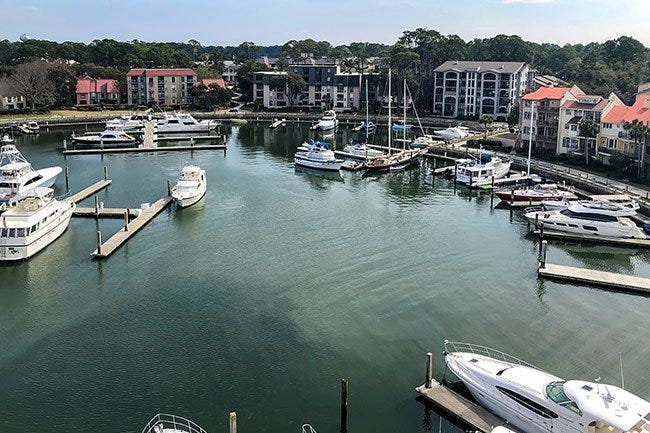
For years, long before moving to Sea Pines, he kept his boat docked in Harbour Town Marina, where he became something of a fixture. During Heritage week, while the other bigwigs were busy chasing golfers and real estate deals, Cloide was busy hosting them. Arnold Palmer used to come aboard his boat every year. They’d drink scotch, talk golf and fishing, and—of course—end up doing a business deal. Because that’s who he was. You came for the cocktail, some fresh shrimp, and left with a signed contract.
Thanks for stopping by. You are invited to become a subscriber and never miss a story. Sending love and best wishes for the best Heritage Week ever!!!