
The Club to Nowhere
How did hands dusted with flour become the fuel for freedom?

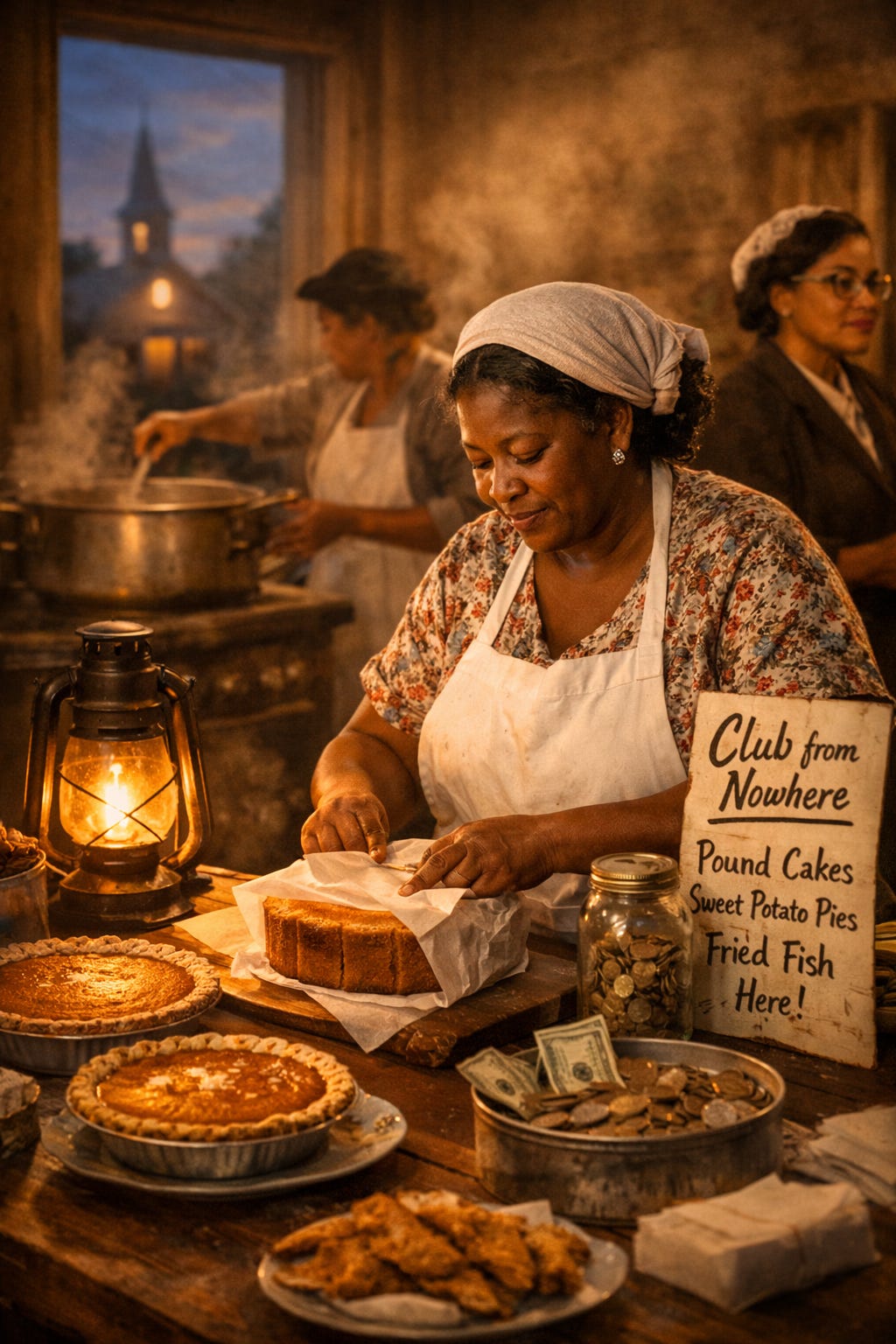
Thanks for stopping by this special place—a place that honors connection, hope, creativity, and resilience. The South Carolina Lowcountry is my center of gravity, where stories rise like tidewater, often when you least expect them. It’s where we gather as a community of creatives, united by a shared faith in the power of storytelling, good food, and fellowship. Step in. Sit a spell. Make yourself at home. We’re glad you’re here. Today’s story is about hope, creativity, and the resilience of a group of women who rose before dawn to bake, while risking their jobs and safety for a cause they believed in. It’s a timely story as we pause to remember Martin Luther King this week, known for his nonviolent protests for the cause of civil rights.
Heroes often arrive in our history books fully formed - brave, resolute, larger than life. But the truth is quieter and far more human.
Rosa Parks was not born a symbol. She was a seamstress. A wife. A woman who got tired at the end of the day. She worried about money, about safety, about doing the right thing in a world that punished Black people for the smallest acts of resistance. When she refused to give up her seat on that Montgomery bus in December 1955, it was not because she was fearless—it was because she was resolved. She had reached the place where dignity mattered more than comfort, and conscience outweighed fear.
Two months before Parks’ arrest, another woman was already resisting in her own quiet, determined way.
In the fall of 1955, Georgia Gilmore stepped onto a crowded Montgomery bus after finishing her shift as a cook at the National Lunch Company. She dropped her fare into the box, as required, and the driver ordered her back off the bus to reenter through the rear door. When she obeyed, the bus pulled away, leaving her standing there—humiliated, stranded, furious, and burning with resolve.
Georgia Gilmore didn’t give speeches. She didn’t march at the front of crowds. She went home and did what she knew how to do best.
She cooked.
Gilmore understood something profound: movements are sustained not only by courage, but by logistics. By meals. By money. By women who show up every day. She gathered other Black women—maids, cooks, domestic workers—and together they baked pound cakes, sweet potato pies, and cooked fried fish dinners. They sold them quietly through churches and beauty salons, places where Black women had always gathered and where home-cooked food was never questioned.
If anyone asked where the money came from, the answer was simple and brilliant: nowhere.
They called themselves the Club from Nowhere.
That humble 1950s pound cake—dense, buttery, wrapped in wax paper—became something far more than dessert. It became fuel for freedom. The money raised paid for gas, car repairs, and alternative transportation during the Montgomery Bus Boycott, when Black residents refused to ride segregated buses. These were the very people who depended on buses to get to work, and their absence was impossible to ignore.
While men debated strategy and courts deliberated law, women baked. While history focused on speeches and arrests, kitchens became command centers. The pound cake—an everyday Southern staple—turned into an act of defiance, a quiet economy of justice operating beneath the notice of white Montgomery.
And Rosa Parks? She understood this network of women. She was part of it. Her courage was not solitary—it was held up by hands dusted with flour, by women who rose before dawn to bake, who risked their jobs and safety to keep the movement alive.
A little over a year later, in November 1956, the U.S. Supreme Court struck down laws requiring segregated seating on public buses. In December, Martin Luther King Jr. called for an end to the boycott.
History remembers the verdict. It remembers the speeches. But it should also remember the cakes cooling on kitchen counters, the coins collected in envelopes, the women who turned domestic labor into political power.
That is the human side of heroism.
Sometimes justice doesn’t arrive with a raised fist. Sometimes it comes wrapped in wax paper, carried into a church hall, and sold slice by slice—sweet, steady, and strong enough to change a nation.
These stories are invaluable to our nation's history and growth as it evolved into a free and equal country for all. Thank you for sharing them.
Pat, I love this story. My childhood memories include fondly my "maid", Bernice making pound cake. Not using measuring cups but her hand. It was the best pound cake! Bernice raised me, my mom was divorced and a doctor, so Bernice and her husband David lived in the apartment over the garage and was with me all day and many times into the night. She was my second mom.
I also remember riding the bus to downtown, Bernice sitting in the back with myself and my siblings sitting up front. I never understood that. I now wonder if she also baked pound cake to sell.