
The Unforgettable Miss Dora
A true story from my upcoming book, No Safe Harbor.

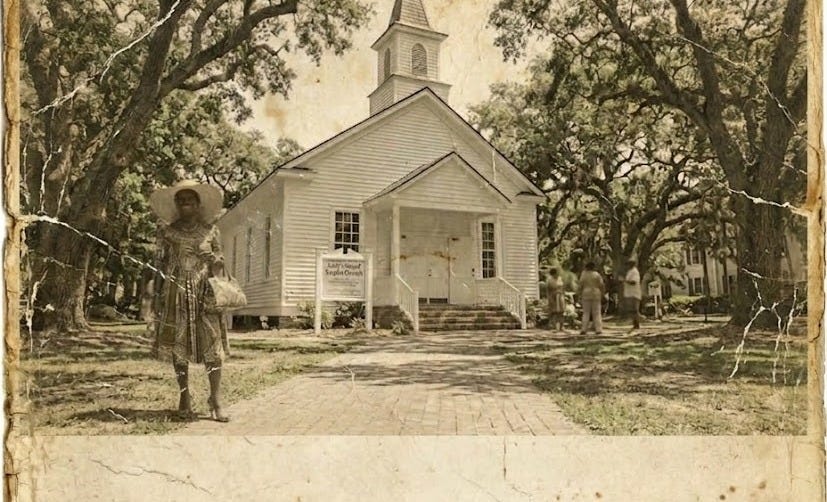
Shortly after moving to Beaufort decades ago, Sundays became days that were never about getting anywhere fast. They were about letting the day wander where it pleased. I’d rumble past porches painted haint blue - because I was told evil spirits were never welcome to supper.
A little further down the road, past the Lady’s Island Baptist Church, I noticed Miss Dora by the side of the road. She’d hitchhike every week dressed to the nines, with her big-brimmed straw hat, high-heeled shoes, and a matching handbag. She was only 5 feet tall at the most and a sight to behold. I rolled the window down. “Get in, I’ll give you a ride home.” With a big smile, she climbed into the front seat. “I’m on my way home to get lunch ready,” I said, but I don’t know how to cook anything around here. I want some of that fresh flounder and maybe try out the blue crab, but what do you do with it?”
“Youse southern and youse can’t cook?” Don’t make no sense. Dora shook her head and looked at me with a long, puzzled gaze. A Gullah native from Brickyard Point who grew up beside her Grandma, Tulu, who, for as far back as she could remember, was the cook at the Sea Island Motel. Dora had learned a thing or two about Lowcountry cookin’.
“Tulu and I - weese goin’ up to the dam. Come on and go with us,” said Dora. Next thing I knew, I was carrying a bunch of smelly chicken necks, a few bamboo poles, and some string.” Dora grew up beside Grandma Tulu, cleaning and cookin’ at the Sea Island Motel.
“Youse gonna tie one dem chicken neck to de string and tie ‘em to dat pole obuh deh, den slowly leh de line down eenta de ribbuh,” Tulu say. “In no time tall, you bin feel dat fus’ lil’ tug on de line as de crab start fuh nibble. Pull ‘em ebah so kehful.” Then Dora grabbed my net and scooped ‘em up and tossed ‘em into the tall white bucket that sat on the riverbank. Once we filled it nearly to the brim, we took those rascals kicking and crawling back to the kitchen.
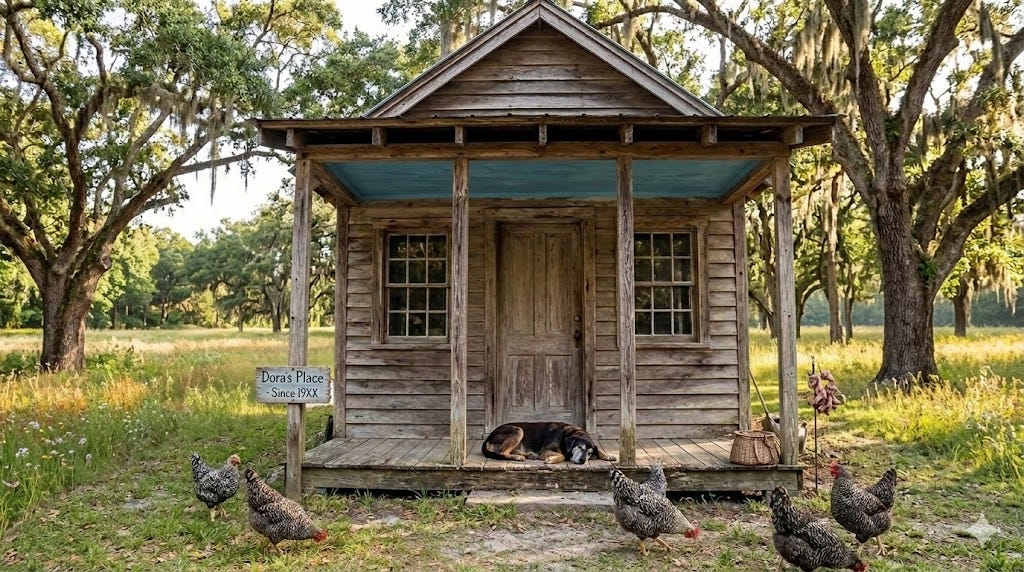
Once back at the house, Tulu got the pots boiling, tossed in the blue crabs, cooked ‘em till their shells were a rusty red color, drained them, then dumped them onto the newspaper-covered porch table. We all sat around, picked every crab with a big bowl in the center - a gracious plenty. Tulu was so happy she’d start to sing an old gospel hymn with her hands held high toward heaven.
Once we finished cleaning all the crabs, I looked over at Dora and said, “How would you like to come to the big house and work for us?” How much are you making downtown at the motel? Whatever it is, I’ll double it. You won’t even have to hitch a ride to town; you can walk from here.”
The look on her face said it all. And just like that, Dora became my housekeeper and confidant for the next 8 years.
Dora knew everyone in town - cause everyone ate breakfast at the Sea Island. Rumor was that a big trial was taking place over at the courthouse. I don’t know exactly what or how she knew, but somehow she knew there was a hint of rot beneath the floorboards and secret ledgers in the salt air. I figured she must have heard or seen something suspicious.
Once I arrived home, Cloide was standing by the window, watching the humid Lowcountry air press against the glass. The weight of the Pleasant Point kickback scheme by the New York banker felt like an anchor; despite his powerhouse legal team, the "big city" money felt like an invincible tide.
The team had arrived in town not with swords, but with a blizzard of white paper, intending to bury the truth under a mountain of motions and mandates. These were vultures in silk suits, circling the case with a calculated intent to pick it clean through endless, hollow filings.
While the Lowcountry moved by the tides, these men moved by the ledger, seeking to choke the life out of the claim with a relentless, mechanical flood of documentation.
Dora noticed Mr. Cloide and bravely approached him. “You sees ‘em.” She referred to the banker’s team. “Them monsters don’t stay in them swamps or in pluff mud.” She adjusted her starched apron, her eyes fixing on him with a sudden, piercing intensity. She leaned in, her voice low, "This ain't a fight for a gavel," she said softly. "This is a fight for da spirit of da thing. If you want to sway da wind and make sure this trial lands in your favor, you need to go see Dr. Buzzard. Fred Buzhardt knows the law of the land, but Dr. Buzzard knows da law of the root. One works da books, the other works da hearts. If I were you, I'd be making a trip to St. Helena once da sun sets."
Dora moved in closer to say, “Justice don’t always move in a straight line.”
And so it was. The story unfolds, showing a system protected by corruption that hides behind tradition and respectability. At a time when Southern narratives are being reconsidered and reclaimed, this book challenges romanticized ideas of honor and civility by revealing the cost of silence and how deeply corruption can be embedded beneath genteel manners, historic preservation, and Southern hospitality.
At its heart, No Safe Harbor is not simply a crime story. It is about how power protects itself, how communities close ranks, and how danger in the South often arrives with charm, invitation, and impeccable manners.
The narrative blends memoir, social history, and how the High Sheriff, with his buddy Dr. Buzzard, ruled through witchcraft, superstition, and their own investigative reporting.
I very much enjoyed this chapter, Patricia! Auto-Fiction/Memoir is my favorite. Happy Writing!🤠🤙
I am delighted to have found you online, Pat! You knew me as Mary Westmoreland, and our sons played baseball together as children. I believe we also carpooled when the children were in Montessori School. I met you all through Fred Buzhardt - I was his secretary. I loved seeing his name in the same sentence with Dr. Buzzard in this post! I have subscribed and am ordering your books! So pleased to read your wonderful writing.